Ask a lab owner what would break if they took two weeks off, and most of them laugh before they answer. The laugh is the answer. Every lab we talk to runs on a layer of knowledge that no dental lab management software was ever given, because nobody ever wrote it down.
The knowledge that never made it into the system
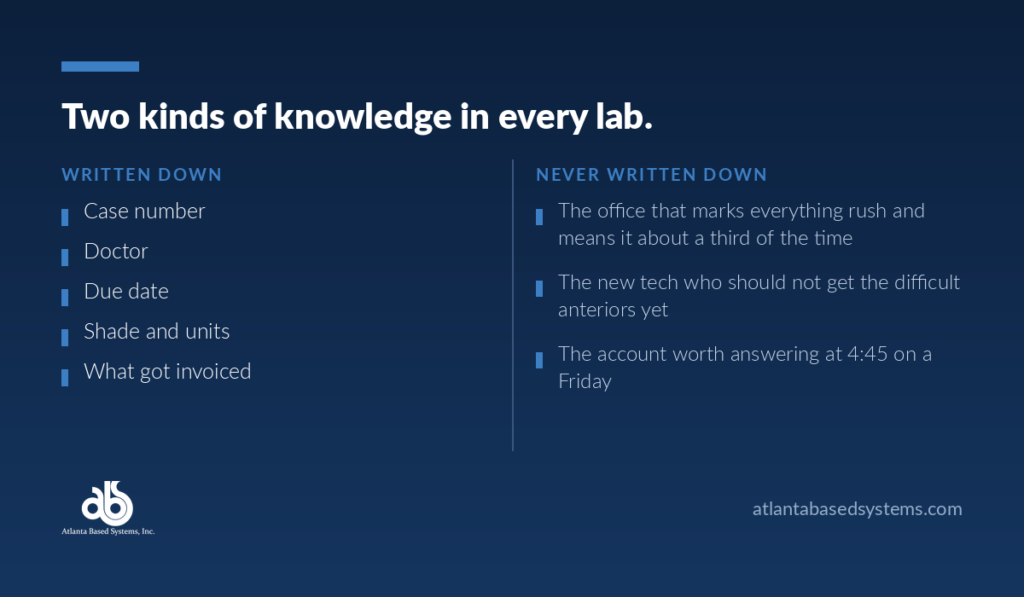
Your system knows the case number, the doctor, the due date, the shade, and the units. It knows what got invoiced.
It does not know that one of your offices marks everything rush and means it about a third of the time. It does not know that the crown and bridge tech who joined in March should not get the difficult anteriors yet. It does not know that when a certain account calls at 4:45 on a Friday, the right move is to answer, because that account has never once been unreasonable and has never once been late paying.
That knowledge is real, it is valuable, and in most labs it lives in one or two heads. Usually the owner’s. Sometimes it belongs to a twenty year technician, or the one administrator who has been there long enough to remember three phone systems.
What actually breaks when that person is out
It is rarely production. Cases still get made. Technicians are good at their work and they keep doing it.
What breaks is everything around the case. Routing decisions get made by whoever is nearest instead of by whoever knows. Doctor preferences get missed, which turns into an adjustment, which turns into a remake nobody counted on. Exceptions pile up: the account with the custom pricing, the case that is supposed to ship direct, the doctor who never gets charged for the second try-in. Somebody has to guess, and guesses are expensive.
And the calls. When the person who knows everything is not there, the phone becomes the backup system. Technicians get interrupted to answer questions that are not technical questions. A lab that was quietly efficient on Monday feels chaotic on Thursday, and nothing about the work itself changed.
Why being good at it makes it worse
Here is the part that is hard to hear. The better that one person is, the less the lab ever needed to write anything down.
A lab with an owner who remembers everything has no forcing function to document anything. Every year that owner gets better and faster, and every year the gap between what the lab knows and what the lab has recorded gets wider. Competence hides the risk instead of removing it. It is the same reason the best technician on your bench is often the one with no written notes on their own process.
This matters more now than it did ten years ago. Owners are getting closer to retirement, buyers are asking harder questions during diligence, and a lab whose operating knowledge cannot be transferred is a lab that is worth less at the moment of sale than the owner thinks it is.
What dental lab management software can and cannot carry
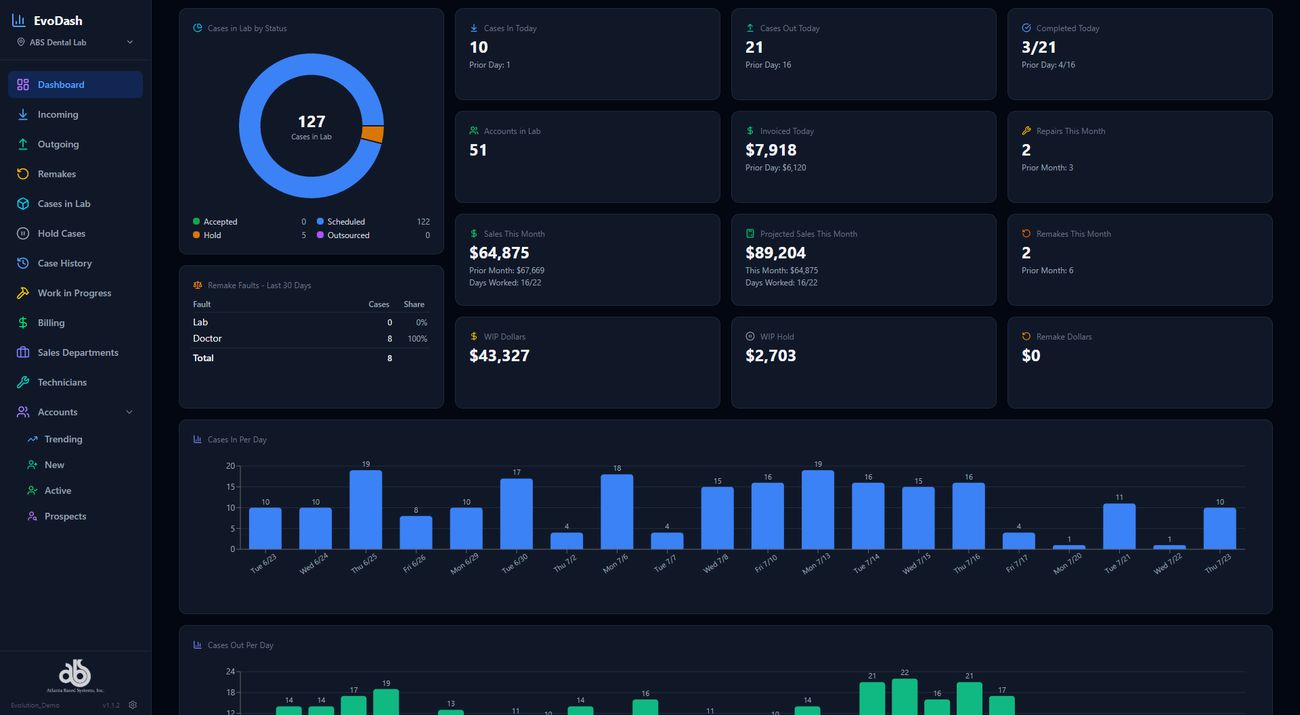
Software is very good at holding structured knowledge and putting it in front of whoever needs it. Doctor preferences attached to the account rather than to a person’s memory. Pricing exceptions that apply themselves instead of being remembered. Case status that anyone can look up without interrupting a technician. Remake history that shows a pattern rather than a feeling.
Software is not good at deciding what your policy is. It will not tell you which technician should get which case, or which accounts are worth accommodating. Those are judgment calls, and they stay yours.
That distinction is the useful one. The goal is not to replace what the owner knows. It is to move the parts that are rules into the system, so the parts that are judgment are the only things anyone has to interrupt you for.
What this means for your lab
Do not start with a documentation project. They die in week two, every time.
Start with one exercise. For one week, write down every question somebody had to ask you that only you could answer. Not the decisions. The questions. At the end of the week, look at the list and sort it into two piles: things that are actually a rule, and things that are actually a judgment call.
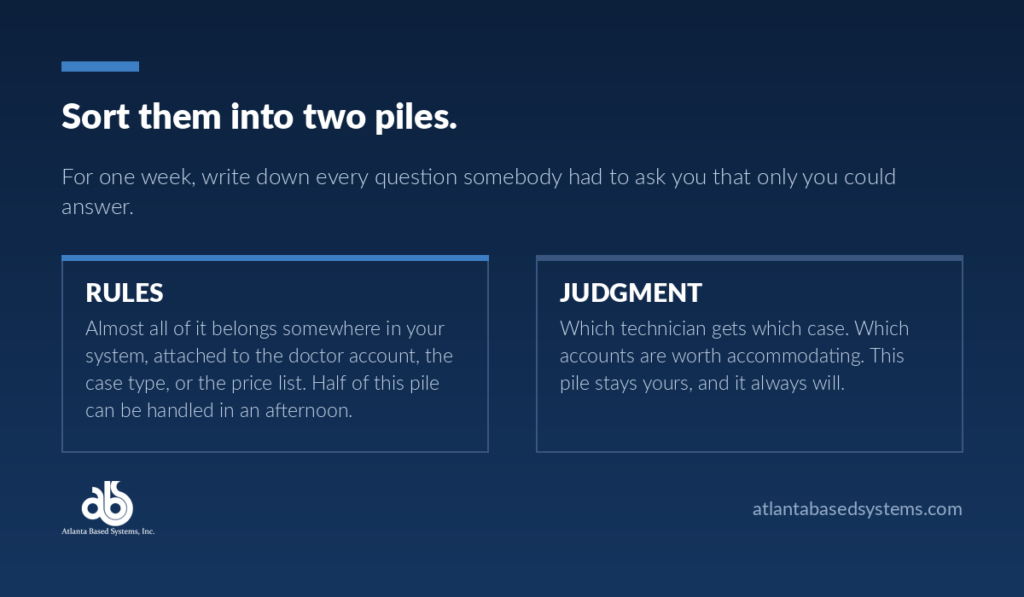
The rules pile is the work. Almost all of it belongs somewhere in your system, attached to the doctor account, the case type, or the price list. Most labs find that pile is longer than they expected and that half of it can be handled in an afternoon.
Then do the same exercise in six months. If the list is shorter, the lab is less dependent on you than it was, which is the only real measure of whether any of this worked.
See what this looks like in your lab
If this sounds familiar, we would be glad to walk through what a setup looks like for a lab your size, including where the knowledge in your head could reasonably live instead. No commitment required. Contact us and we will find a time.
Learn more about ABS and Evolution
Follow ABS on Facebook, Instagram, LinkedIn, and X. Please contact us directly if you’d like to learn more about Evolution dental lab management software.