
If someone called your lab asking about a complaint from two months ago, how long would it take your team to piece together what happened?
Not a trick question. Most labs can get there eventually. There’s an email thread somewhere, a note someone made, a conversation someone remembers. But “eventually” is the problem. The information exists; it just isn’t in one place, accessible to whoever’s on the call.
That’s the gap a good CRM closes. And it shows up in three specific ways before labs usually decide to do something about it.
1. Your team gives different answers about the same account.
This one’s subtle at first. A customer calls in and gets one picture of where things stand. A few weeks later they call back, and a different team member has a different read, because the last interaction wasn’t logged where everyone could see it.
Nobody’s being careless. The information just isn’t shared. When customer history lives in individual inboxes and memories, every conversation starts from a slightly different baseline.
A CRM means everyone on your team (front desk, customer service, the manager, the field rep on the road) is looking at the same record. Same account, same history, same last interaction.
2. You only know what your staff remembers to log.
Here’s the part most labs don’t think about: the doctor is doing things too.
They’re submitting prescriptions, adding notes to cases, making payments, requesting pickups. In most systems, none of that activity makes it into the customer record unless someone at the lab manually captures it. Which means the “complete” picture of a customer relationship is actually only the lab’s half of it.

Evolution’s CRM works differently. Every action a doctor takes in the EvoDOCTOR portal (case submissions, notes, images, payments, pickup requests) is automatically recorded as a CRM activity. No staff entry required. The doctor generates it; the system captures it, tied to that account, visible to everyone.
So instead of asking “what has this doctor been doing?” and waiting for someone to remember, the answer is already there.
3. You don’t know which accounts are quietly trending down until they cancel.
A doctor who used to send thirty cases a month is now sending twelve. Nobody mentioned it. Nobody flagged it. It happened gradually over six months, and by the time anyone noticed, the account had gone quiet.
Labs with good account visibility catch this early. They see the volume change, they make a call, and they find out what shifted. Sometimes it’s solvable. Labs without that visibility often don’t know until a farewell email.


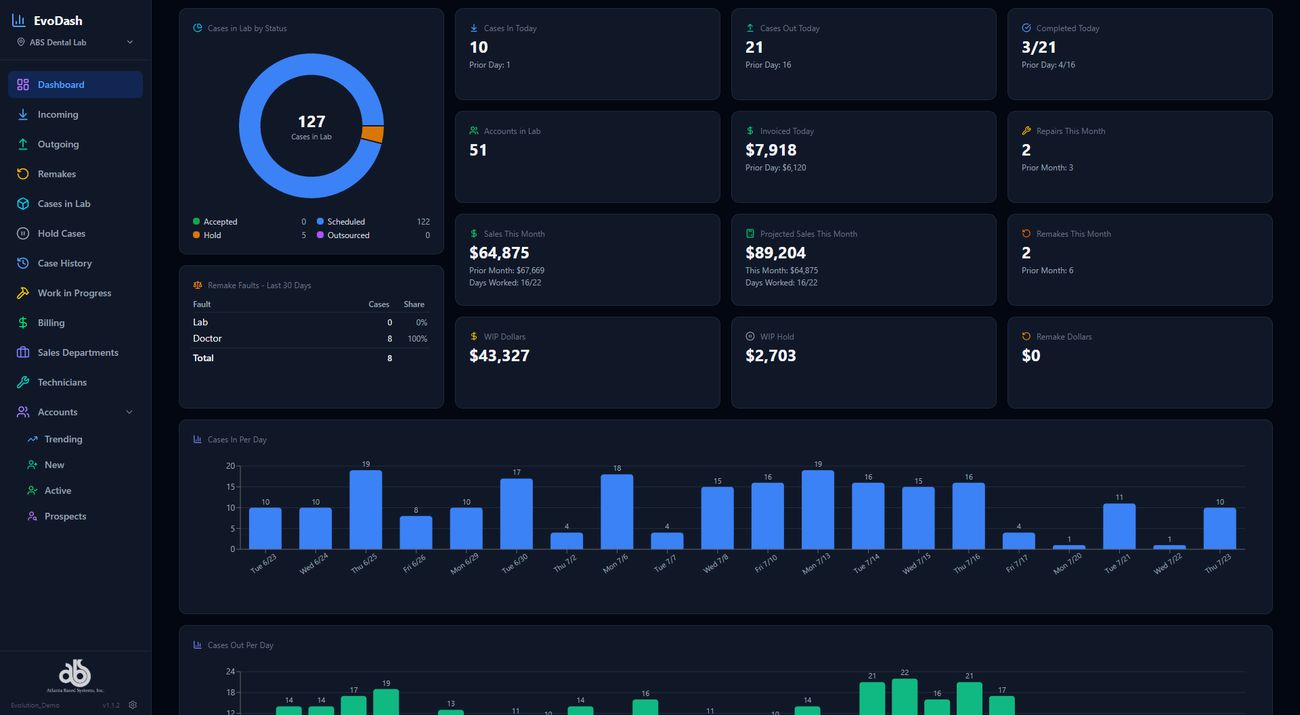
When your lab’s field rep can pull up real-time case volume and account history on their phone before a visit, and when the doctor’s own portal activity is already logged in the same record, the early signals are harder to miss.
What to do about it
If any of these patterns are familiar, the fix usually isn’t more discipline. It’s better infrastructure.
Evolution’s CRM module logs every customer interaction, tracks activity from your staff and your field reps in real time via EvoSALES, and automatically captures doctor-side activity through the EvoDOCTOR portal. It’s built into the same interface your team uses for cases and billing, so the information ends up in one place instead of scattered across three.
If your lab is managing more relationships than you can comfortably keep in your head, it’s worth a look at what you might be missing.
We’re happy to walk through it. No commitment, just a look at what the alternative actually involves.
LEARN MORE ABOUT ABS AND EVOLUTION
Follow ABS on FaceBook, Instagram, LinkedIn, and X. Please contact us directly if you’d like to learn more about Evolution dental lab management software.