
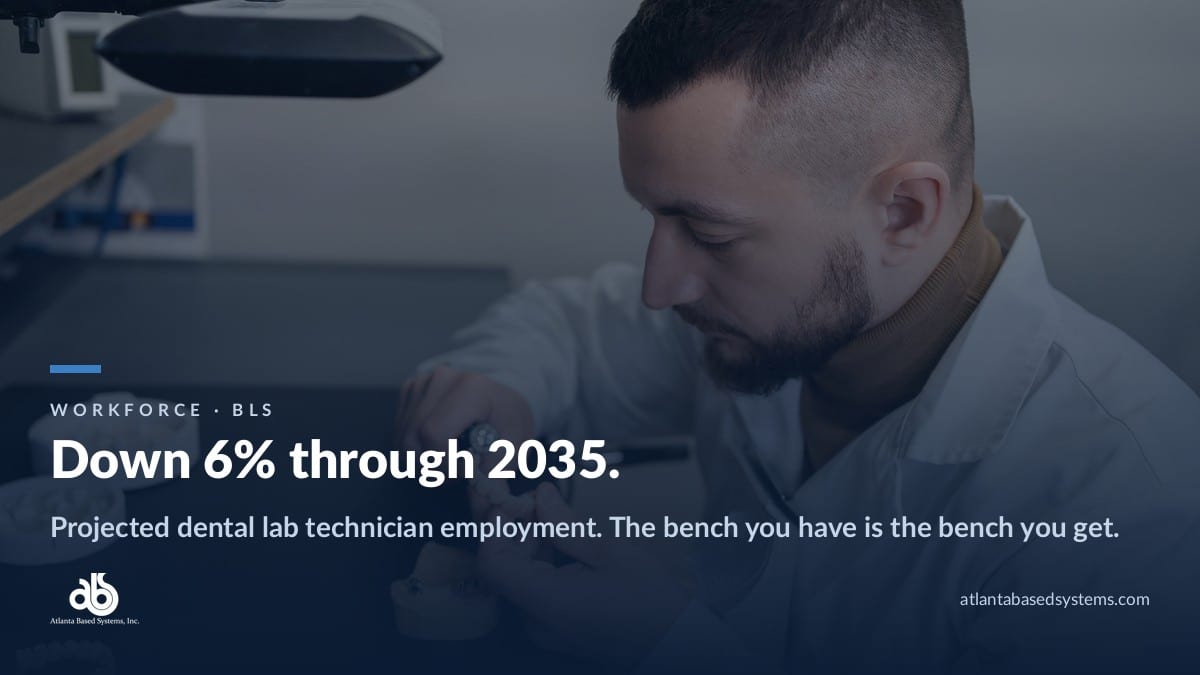
The Bureau of Labor Statistics refreshed its dental laboratory technician outlook on August 27. There are 34,400 people in the job. The projection through 2035 is a 6% decline, roughly 2,000 positions.
One note on reading the source, because the headline figure on that page is not the one that matters here. BLS groups dental laboratory technicians together with ophthalmic laboratory technicians and medical appliance technicians, and that combined group of 64,300 is projected to decline 2 percent. The dental laboratory technician line inside it is the one falling 6 percent, from 34,400 to 32,300. The other two occupations in the group are projected to grow slightly, which is what pulls the headline up.
Numbers like that usually get read as industry commentary and then filed. This one is worth reading as an operating constraint instead, because it describes the single input most lab capacity planning still takes for granted.
What the projection actually says
It does not say case volume is falling. Restorative demand is not the variable here. What the projection describes is the supply of people qualified to do the work, and it says that supply gets tighter every year for the next decade.
For most of the last thirty years, a growing lab could solve a capacity problem by hiring. It was not easy or cheap, but it was a solved category of problem. Post the role, wait, train, absorb the volume. Every plan for adding a major account has that step in it somewhere, usually unstated.
That step is the one getting less reliable. Not impossible, but slower and more expensive each cycle, with fewer trained candidates entering the field than leaving it. A growth plan whose second step is “and then we hire two more technicians” is now carrying a risk it was not carrying in 2015.
The automation explanation is half right
BLS gives a reason for the decline. The handbook attributes it to 3D printing and other laborsaving technologies being increasingly used to produce dental parts and appliances.
That is true as far as it goes, and it is easy to over-read. Printing and milling did not delete the labor. They relocated it, mostly upstream into design and downstream into quality control.
Somebody still builds the file. Somebody nests the tray, places the supports, runs the wash and cure, separates parts, and inspects a batch where a single upstream error means all forty units are wrong in the same way. The hours moved. They did not evaporate.
What did change is the shape of the risk. A technician hand-finishing one unit at a time makes small, contained mistakes. A technician approving a nest makes one decision that lands on forty units at once. Fewer seats, each carrying more consequence, each harder to fill.
Which means the practical conclusion for a lab is close to the opposite of the comfortable one. Automation does not reduce the hiring problem. It concentrates it.
The question that replaces “how many techs do I need”
If adding bench capacity is the unreliable move, the reliable move is knowing precisely what the current bench produces and where that production leaks.
Almost every lab can produce a case count and a payroll number. Those two figures bracket the problem without describing it. The useful measurements live between them, and most of them are not hard to capture. They are just rarely captured on purpose.
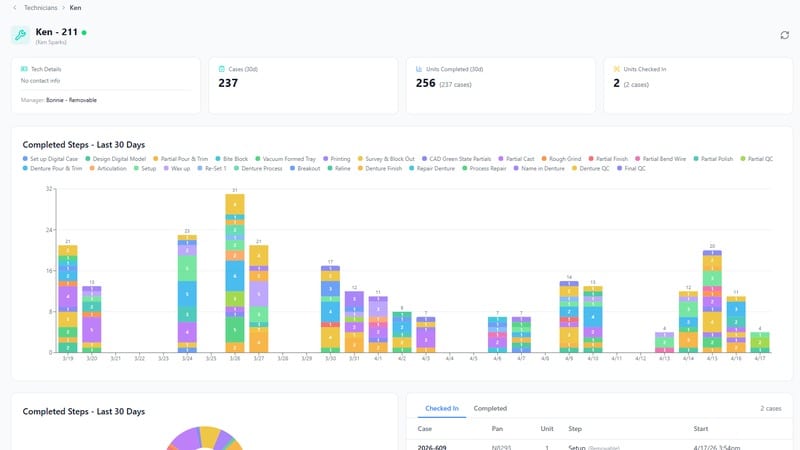
Units per technician per day, by department. A lab-wide average is close to meaningless, because it blends a department running at capacity with one that has room. The constraint is a specific bench on a specific day, and the average is designed to hide it.
Rework rate, broken out two ways. By technician, and separately by account. Remakes are almost never evenly distributed. They concentrate, and the concentration usually has a nameable cause: one technician who needs a specific piece of training, or one practice whose impressions or scans consistently arrive short. Both are fixable. Neither is visible in a lab-wide remake percentage.
Where cases actually sit, versus where the schedule says they should be. The distance between those two is most of a turnaround problem, and it is the number that gets estimated rather than measured most often.
Why this has to be a byproduct, not a project
Here is where most measurement efforts die. Somebody decides the lab needs these numbers, builds a spreadsheet, and asks the floor to feed it. It works for five weeks. Then a busy month arrives, the tally slips, and the data quietly stops being trustworthy right at the moment it would have been most useful.
The version that survives is the one where nobody is asked to do anything extra. Production data has to fall out of moving the case through the lab, so that the report is a lookup rather than a project. If producing the number requires someone to stop and record it, the number will be missing exactly when the lab is busiest, which is the only time anyone needs it.
That is the argument for a system of record rather than a reporting habit. It is also the reason to put one in place before you need the answer, not during the quarter you are trying to fix something.
One test worth running this week
Pick last Tuesday. Answer three questions without asking anyone on the floor.
Which department completed the fewest units relative to what was scheduled into it. Which account generated the most rework in the last ninety days. How many cases were sitting past their promised date at 4pm.
If those are lookups, your capacity planning can be built on real numbers, and the BLS projection is a hiring headwind rather than a strategic threat. If any of them requires a walk through the lab and a conversation, that gap is the thing worth closing first. It will matter more every year that projection holds.
See what this looks like in practice
If you want to see how case tracking, technician productivity and turnaround reporting work together in one system, we are happy to walk through it with no pressure and no obligation. Evolution has been built around dental labs for close to fifty years, and a short conversation is usually enough to tell whether it fits how you already work.
Learn more about ABS and Evolution
Follow ABS on Facebook, Instagram, LinkedIn, and X. Please contact us directly if you’d like to learn more about Evolution dental lab management software.