A few years ago, a digital denture was something you heard about at a trade show. Today it’s what most labs offer.
That’s the headline from Lab Management Today’s 2026 Removable Prosthetic Survey: 58% of responding labs now offer digitally fabricated complete dentures, up 23 percentage points since 2024. On average, more than half of final denture work now uses digital fabrication for all or part of the case, and nine in ten respondents expect that share to keep growing by 2029.
The same survey asked what gets in the way. The answer wasn’t the printer, the resin or the design software. It was inadequate scans and records.
THE TECHNOLOGY IS READY. THE INFORMATION ISN’T.
Anyone who has run a removables department knows the feeling. The scan arrives without a bite. The shade is in a phone message nobody wrote down. A photo of the patient’s old denture went to one person’s inbox and stayed there. The tooth mold is on a sticky note on the box.
With a conventional denture, a technician could often work around a gap with experience and a phone call. A digital workflow is less forgiving. The design is only as good as the data it starts from, and a missing record doesn’t just slow one step down. It can send the case back to the beginning.
There’s a second wrinkle in the survey. On average, only 28% of dentist-clients specifically prescribe a digital denture. Labs are choosing the digital path themselves, which means the lab also owns the job of getting complete records from offices that may not know exactly what a digital case needs.
MAKE THE RECORDS PART OF THE CASE
The labs that handle this well tend to do a few unglamorous things consistently.
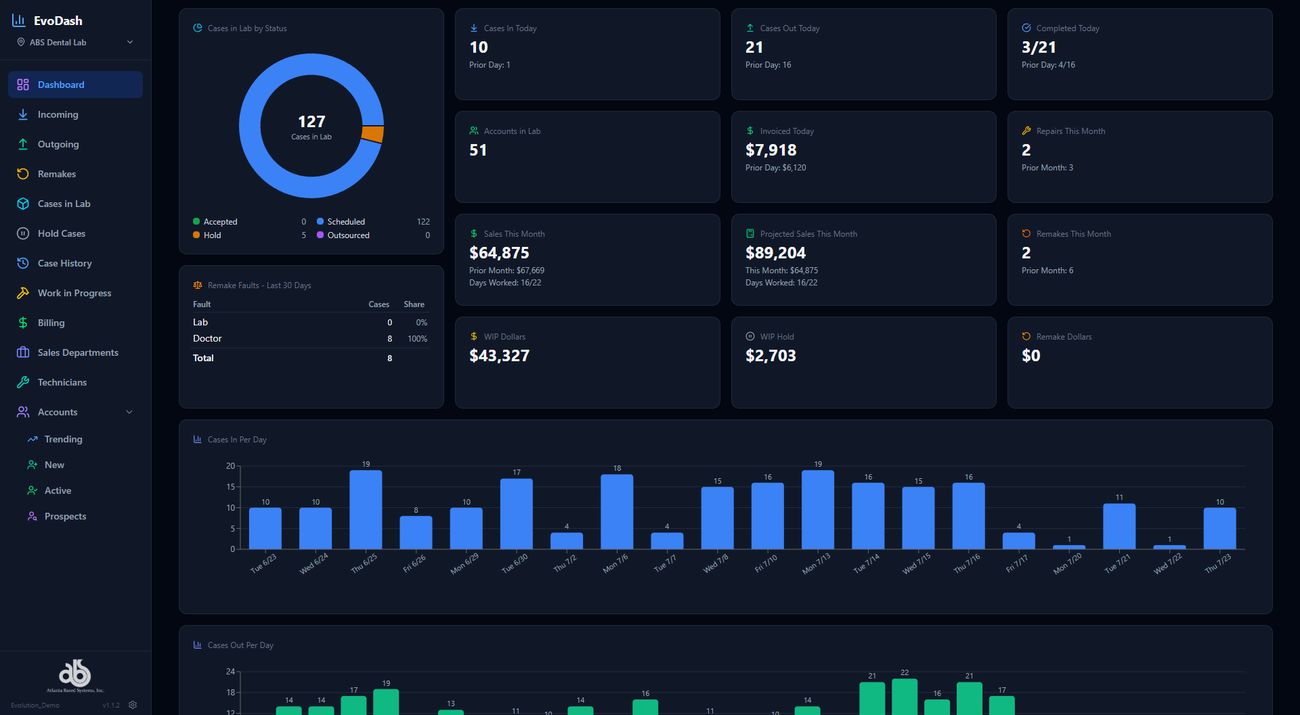
Keep every record with the case. Scans, the Rx, photos and notes belong in one place, attached to the case itself, not split across email, a shared drive and the paperwork in the box. If someone has to go looking, the case is already late.
Make missing records visible. A case waiting on a bite registration or a shade shouldn’t sit quietly on a shelf. Put it on hold with a clear reason so the whole team, and whoever calls the office, can see exactly what’s needed.
Tell doctors what a digital case needs. A short checklist for digital dentures (scan requirements, bite, shade, mold, photos) sent to your offices up front prevents a lot of follow-up calls later.
Make it easy for the office to send more. When a doctor can add a note or an image to a case online, the missing piece arrives in minutes instead of after two rounds of phone tag.
HOW EVOLUTION HELPS
Labs on Evolution attach scanned documents, files and pictures directly to the case, so the record travels with the work through every step. Cases waiting on information go on hold with a reason the lab defines, which keeps them in front of the people who can fix them. And doctors using the EvoDOCTOR Portal can submit cases and add notes and images on their own, with every action recorded in the lab’s CRM.
WHAT THIS MEANS FOR YOUR LAB
Digital dentures are here to stay, and the labs adopting them are getting faster and more consistent. The bottleneck has moved from the bench to the paperwork. Fix how records arrive and where they live, and the printer can do what you bought it to do.
LET’S TALK ABOUT YOUR WORKFLOW
If you’d like to see how other labs keep case records, holds and doctor communication in one place, we’d be glad to show you Evolution in a short call. Book a 15-minute introduction.
Through December 31, 2026, new Evolution licenses and modules are 20% off the one-time license fee.
LEARN MORE ABOUT ABS AND EVOLUTION
Follow ABS on Facebook, Instagram, LinkedIn, and X. Please contact us directly if you’d like to learn more about Evolution dental lab management software.