
Most labs do not wake up one day and decide to replace their management software. The realization builds slowly. A workaround here, an export there, one more monthly fee for a feature that used to be simpler. By the time a lab starts shopping, the frustration has usually been quietly compounding for a year or more.
The hard part is telling the difference between normal growing pains and a system that has genuinely stopped keeping up. Here are five signs it is the software, not you.
1. Adding a user costs more than the user is worth
Per-seat subscription pricing feels reasonable when you have five people. At fifteen, it becomes a tax on growth. Every hire is another monthly line item, and the math quietly pushes you to under-license, share logins, or keep people off the system who should be on it. Good lab software should make it easier to grow your team, not more expensive every time you do.
2. Your second location is bolted on, not built in
Plenty of systems can technically handle more than one site. Far fewer were designed for it. The tell is in the daily friction: separate databases you reconcile by hand, reports that cannot combine locations, pricing and AR that do not stay straight across sites. A platform built for multi-location runs every site on one database, shares what should be shared like products and scheduling, and keeps separate what should be separate like price lists and receivables.
3. You cannot see productivity without exporting it
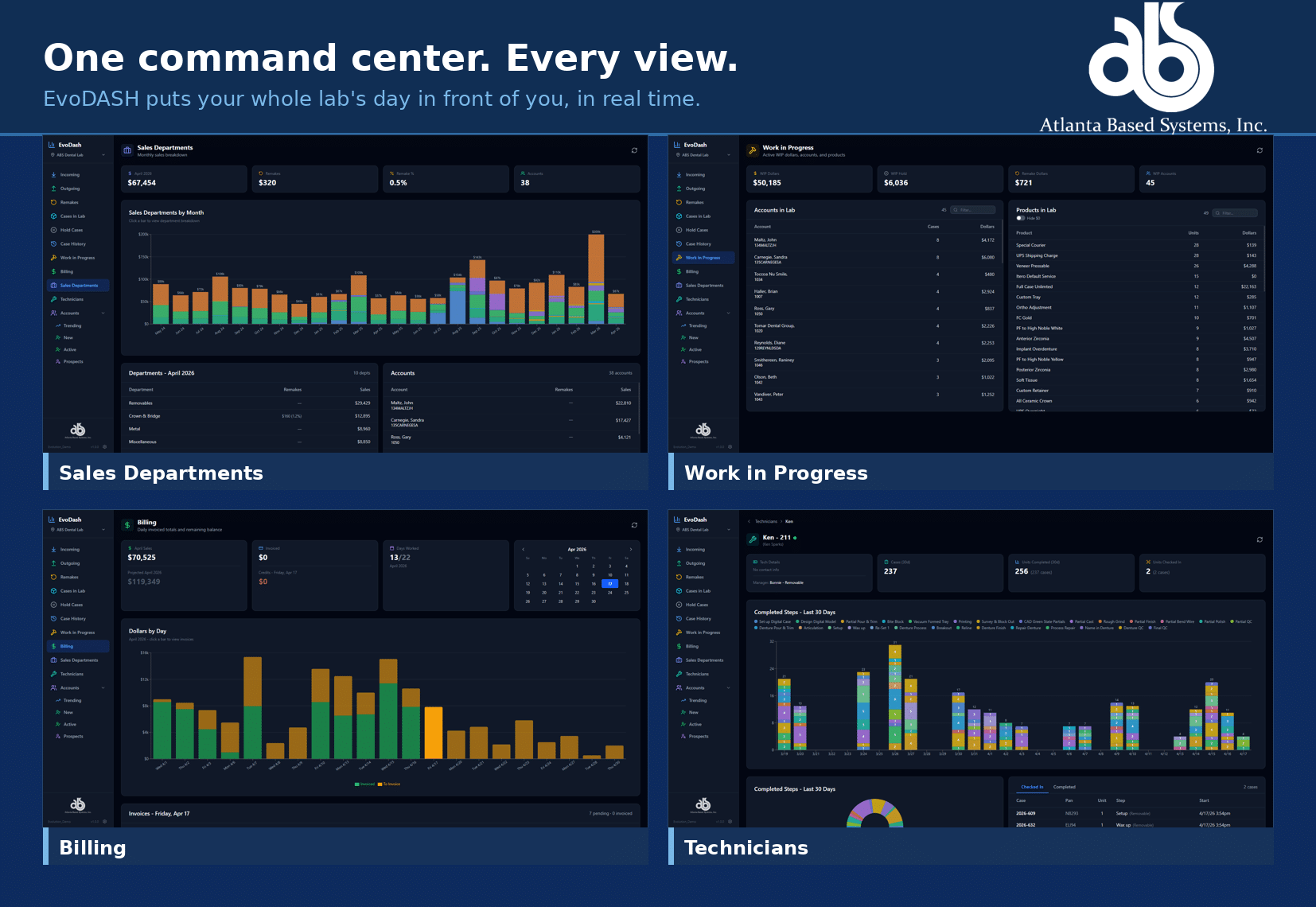
If the only way to know how your technicians are performing is to pull a report after everyone has gone home, you are always managing yesterday. Capacity, efficiency, and case flow should be visible while the day is still happening, in time to actually do something about a bottleneck. When a lab grows past the point where the manager can see the whole floor at a glance, the software has to fill that gap, not widen it.
4. Your CRM only knows what your staff typed in
Most lab CRMs are really just a log of what your team remembered to enter. That leaves out everything your field reps see in the office and everything your doctors do directly. The strongest customer records are fed from all three directions at once: lab staff, field reps, and the doctors themselves, all writing to one shared account history automatically. If your system only captures one of those three, you are seeing a third of the relationship.
5. Your data is not really yours
This is the one labs notice last and regret most. Ask a simple question: if you decided to leave your current software next month, could you take your data with you, cleanly and completely? If the honest answer is “I am not sure,” you do not own your data so much as rent access to it. Owning your database, on your own server and backup drives, is the difference between a vendor relationship and a vendor dependency.
What to do if more than one of these sounds familiar
Recognizing the signs is the easy part. The reason most labs stay on software they have outgrown is not loyalty. It is the fear of switching. Migrating years of cases, accounts, and pricing feels like open-heart surgery on a business that cannot afford downtime.
It does not have to be. The switch is exactly where a software partner earns its keep. At Atlanta Based Systems we assign every new lab a dedicated implementation specialist who handles the migration, trains your team across every role, and stays with you through your first month-end close. We have spent nearly 50 years building Evolution for dental laboratories, and roughly 200 labs across North America run on it today. A good number of them came to us because they had outgrown something else.
If two or three of these signs hit a little close to home, that is worth a conversation. We are glad to show you what your lab looks like on software built to grow with it, no pressure and no obligation.