Month: August 2026

Ask a lab owner what would break if they took two weeks off, and most of them laugh before they answer. The laugh is the answer. Every lab we talk to runs on a layer of knowledge that no dental lab management software was ever given, because nobody ever wrote it down.

The knowledge that never made it into the system

Your system knows the case number, the doctor, the due date, the shade, and the units. It knows what got invoiced.

It does not know that one of your offices marks everything rush and means it about a third of the time. It does not know that the crown and bridge tech who joined in March should not get the difficult anteriors yet. It does not know that when a certain account calls at 4:45 on a Friday, the right move is to answer, because that account has never once been unreasonable and has never once been late paying.

That knowledge is real, it is valuable, and in most labs it lives in one or two heads. Usually the owner’s. Sometimes it belongs to a twenty year technician, or the one administrator who has been there long enough to remember three phone systems.
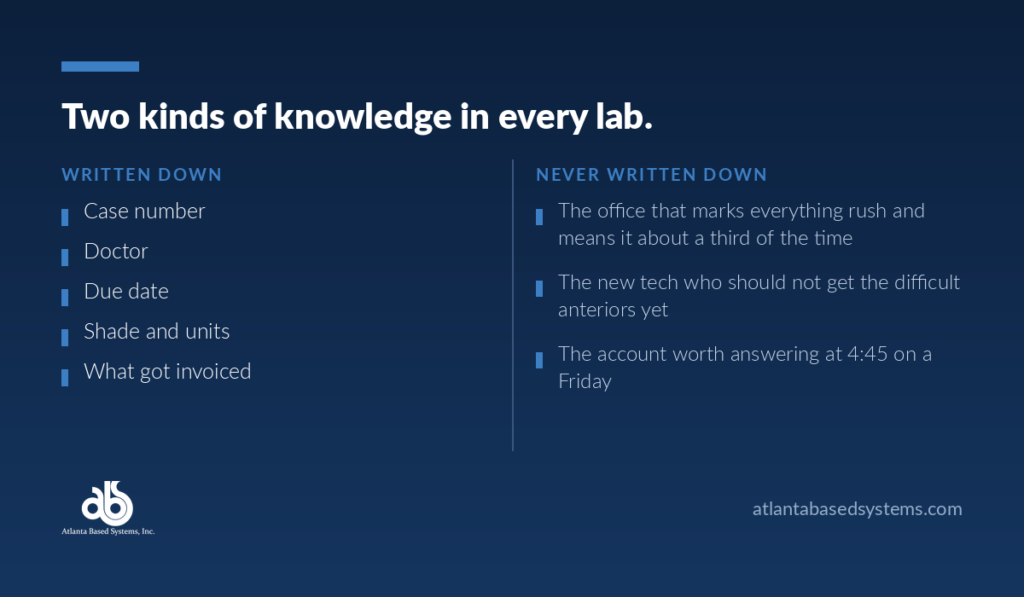
Two-column navy card. Left column, headed Written Down: case number, doctor, due date, shade and units, what got invoiced. Right column, headed Never Written Down: the office that marks everything rush and means it about a third of the time, the new tech who should not get the difficult anteriors yet, the account worth answering at 4:45 on a Friday.

What actually breaks when that person is out

It is rarely production. Cases still get made. Technicians are good at their work and they keep doing it.

What breaks is everything around the case. Routing decisions get made by whoever is nearest instead of by whoever knows. Doctor preferences get missed, which turns into an adjustment, which turns into a remake nobody counted on. Exceptions pile up: the account with the custom pricing, the case that is supposed to ship direct, the doctor who never gets charged for the second try-in. Somebody has to guess, and guesses are expensive.

And the calls. When the person who knows everything is not there, the phone becomes the backup system. Technicians get interrupted to answer questions that are not technical questions. A lab that was quietly efficient on Monday feels chaotic on Thursday, and nothing about the work itself changed.

Why being good at it makes it worse

Here is the part that is hard to hear. The better that one person is, the less the lab ever needed to write anything down.

A lab with an owner who remembers everything has no forcing function to document anything. Every year that owner gets better and faster, and every year the gap between what the lab knows and what the lab has recorded gets wider. Competence hides the risk instead of removing it. It is the same reason the best technician on your bench is often the one with no written notes on their own process.

This matters more now than it did ten years ago. Owners are getting closer to retirement, buyers are asking harder questions during diligence, and a lab whose operating knowledge cannot be transferred is a lab that is worth less at the moment of sale than the owner thinks it is.

What dental lab management software can and cannot carry

Software is very good at holding structured knowledge and putting it in front of whoever needs it. Doctor preferences attached to the account rather than to a person’s memory. Pricing exceptions that apply themselves instead of being remembered. Case status that anyone can look up without interrupting a technician. Remake history that shows a pattern rather than a feeling.

Software is not good at deciding what your policy is. It will not tell you which technician should get which case, or which accounts are worth accommodating. Those are judgment calls, and they stay yours.

That distinction is the useful one. The goal is not to replace what the owner knows. It is to move the parts that are rules into the system, so the parts that are judgment are the only things anyone has to interrupt you for.

What this means for your lab

Do not start with a documentation project. They die in week two, every time.

Start with one exercise. For one week, write down every question somebody had to ask you that only you could answer. Not the decisions. The questions. At the end of the week, look at the list and sort it into two piles: things that are actually a rule, and things that are actually a judgment call.
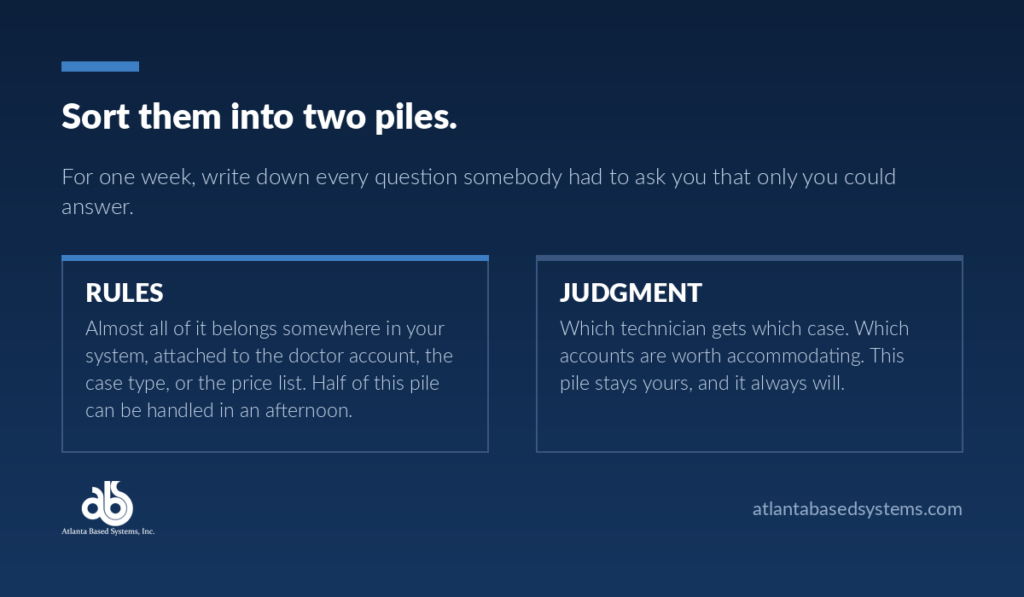
Navy card headed Sort them into two piles. Two boxes below it. Rules: almost all of it belongs somewhere in your system, attached to the doctor account, the case type, or the price list. Judgment: which technician gets which case, which accounts are worth accommodating, this pile stays yours.

The rules pile is the work. Almost all of it belongs somewhere in your system, attached to the doctor account, the case type, or the price list. Most labs find that pile is longer than they expected and that half of it can be handled in an afternoon.

Then do the same exercise in six months. If the list is shorter, the lab is less dependent on you than it was, which is the only real measure of whether any of this worked.

See what this looks like in your lab

If this sounds familiar, we would be glad to walk through what a setup looks like for a lab your size, including where the knowledge in your head could reasonably live instead. No commitment required. Contact us and we will find a time.

Learn more about ABS and Evolution

Follow ABS on Facebook, Instagram, LinkedIn, and X. Please contact us directly if you’d like to learn more about Evolution dental lab management software.
The National Association of Dental Laboratories built a two-day certificate program this year, and the reason they gave for it is the most useful sentence in the industry right now: the need for qualified managers has been identified as one of the top issues currently impacting the dental laboratory industry.

Not equipment. Not offshore pricing. Managers.

HOW MOST LAB MANAGERS GET THE JOB

The path is nearly universal. Someone is the strongest technician in the department. They are fast, their remakes are low, and other techs already ask them questions. A department opens up, and promoting them is the obvious call.

Then the job changes underneath them. The skill that earned the promotion, doing excellent work with their hands, is not the skill the new role needs. The new role needs capacity planning, exception handling, and the willingness to interrupt someone else’s work. Most new managers get none of that in writing. They get a title and a department.

What follows is predictable. They keep doing bench work, because bench work is what they are good at and what feels productive. The management half happens in gaps. Cases go late for reasons nobody catches until a doctor calls, and the lab absorbs the cost of a manager who is now neither a full technician nor a full manager.

THE FIRST NINETY DAYS ARE A VISIBILITY PROBLEM

Ask a new production manager three questions on a Tuesday afternoon and you will learn where the real gap is.

Which cases in your department are late right now. Which technician is behind. What is on hold, and why.

At most labs, those answers live in three places: a list printed this morning, someone’s memory, and a walk to the back of the building. A manager with fifteen years in the department can run on that. They know which doctor calls at 4:00 and which tech gets quiet when they are underwater. That is pattern recognition built over a decade, and it is not transferable.

A manager in month three has none of it. Every question costs a lap around the floor, and the laps are why they are not managing.

WHAT TO GIVE THEM INSTEAD

Three things close most of the gap, and none of them require a new hire.

Set the teams up properly first. In Evolution, production manager tools depend on technicians being linked to their managers in the Managers form under the Maintenance menu. Labs skip this, then conclude the tools do not work. They work. They just have nothing to filter on until the teams exist. Do this before anything else.

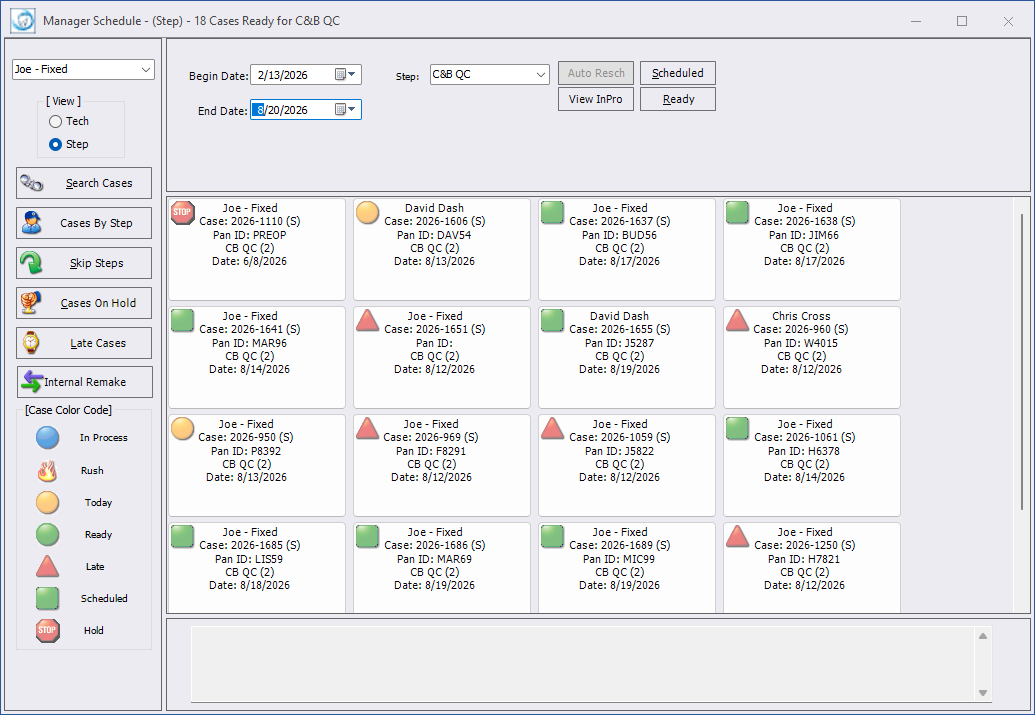
Give them the manager view, not the lab view. A lab-wide late case list is not a management tool for a department head, it is noise with their cases buried in it. What a production manager needs is their own bench, filtered to their own technicians, current as of now. Evolution’s manager schedule and manager dashboard do that filtering, which is the whole reason the team setup matters.

Let them fix things from where they are standing. Most of a manager’s day is exception handling: reassign this case, put that one on hold, bypass a step, print an updated work ticket. If every one of those requires walking back to a desk, they will batch them, and batching exception handling is how cases go late quietly. The EvoMGR tablet app exists to move those actions to the bench.

WHAT VISIBILTY DOES NOT FIX

Software will not make someone a good manager. It does not teach them how to tell a technician their work is slipping, or how to decide which of two late cases gets the last hour of the day. Those are judgment calls, and judgment comes from doing the job with feedback.

What visibility does is shorten the feedback loop. A manager who can see that a case sat idle for nine hours learns something on Tuesday instead of finding out at the end of the month. That is the difference between two years of learning and six months of it.

It also makes the training conversation possible. You cannot coach someone on a decision you cannot see them make. Once the department’s data is visible to both of you, a weekly fifteen-minute review of what went late and why becomes the apprenticeship the industry never built.

WHAT THIS MEANS FOR YOUR LAB

If you promoted a technician into a management role in the last two years, assume they are carrying this gap and assume they will not raise it. People who were promoted for competence rarely volunteer that they feel incompetent.

Start with three concrete steps. Confirm the manager teams are actually set up in your system, because half of labs find out they never were. Sit with the new manager and watch them answer the three questions above, timing how long each takes. Then hand them the tools that shorten the answer.

NADL is running its management certificate program in Tempe on September 17 and 18. If you have a new manager, that is two days well spent.

SEE WHAT THIS LOOKS LIKE IN YOUR LAB

If you are on Evolution and are not sure whether your manager teams are configured, we will walk through it with you. No commitment, and it usually takes under half an hour. Contact your favorite ABS Support technician.

Learn more about ABS and Evolution

Follow ABS on Facebook, Instagram, LinkedIn, and X. Please contact us directly if you’d like to learn more about Evolution dental lab management software.
Eight dental lab deals have been announced so far in 2026, one short of the pace set in 2021. That number is getting read as a signal to sell. We think it is a better signal about what makes a lab durable.

What changed in this wave

The last big consolidation cycle ran on a scale thesis. Buy labs, centralize production, pull cost out of the middle, and let the volume do the work. It worked in some cases and produced a lot of unhappy technicians in others.

The 2026 deals look different. The recapitalization of Apex Dental Laboratory Group by LongueVue Capital and Swaney Group Capital in March, and Catalis Dental Lab Partners picking up Revolution Dental Lab, JB Dental Lab and Avaneer Dental Studio, share a common characteristic. The coverage describes buyers underwriting domestic manufacturing capacity and digital capability, and treating both as competitive moats rather than overhead.

That is a real shift. Domestic production went from being the expensive option to being the defensible one, and the tariff environment did most of the work in getting it there.

The part that has nothing to do with selling

Here is why this matters to a lab that will never take a call from a banker.

If buyers are paying a premium for domestic capacity, digital workflow and provable operating performance, those three things are not deal characteristics. They are competitive characteristics. The lab down the road is not going to beat you because it got bought. It is going to beat you if it can quote faster, turn cases faster, and show a doctor a remake rate.

The first two are equipment and process decisions. The third one is where most independent labs quietly lose ground, and it is the cheapest of the three to fix.

The numbers a buyer asks for, and why you need them anyway

Due diligence on a lab is not exotic. It comes down to a handful of questions.

What is the remake rate, and does it break out by technician, by account, and by product? What does AR aging look like past 30, 60 and 90 days? What is unit throughput per technician? Which accounts are growing, and which have quietly shrunk 20% over eighteen months?

Most lab owners have a feel for all of these. Very few can produce the actual figures without a week of spreadsheet archaeology, and the figures that come out of that week describe a lab that no longer exists.

That gap is expensive long before anyone is buying anything. A remake rate that drifts from 4% to 7% costs real money for months before it shows up in a P&L. An account that slides from net 30 to net 75 does the same thing to cash. A technician whose throughput dropped after a workflow change is a problem you want to catch in three weeks, not at year end.

None of that requires a transaction to be worth knowing.

What a good version of this looks like

The labs that handle this well are not running more reports. They are running fewer, and looking at them more often.


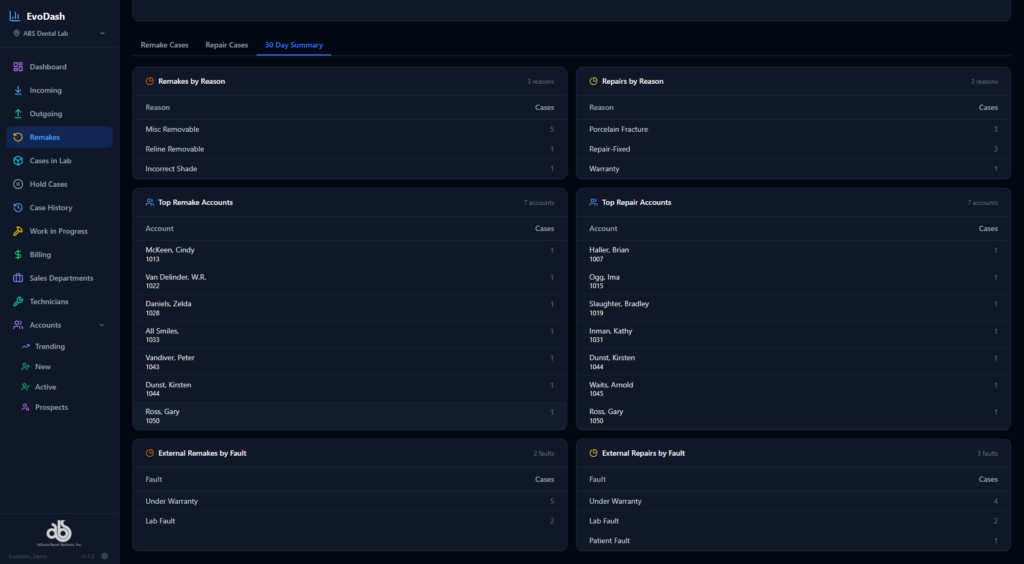
A weekly glance at remake rate by account catches quality drift while it is still a conversation and not a lost customer. A daily look at what has been finished but not yet invoiced turns billing from a month-end scramble into a Tuesday task. Technician throughput compared week over week tells you whether the new mill actually did what the salesperson said it would.

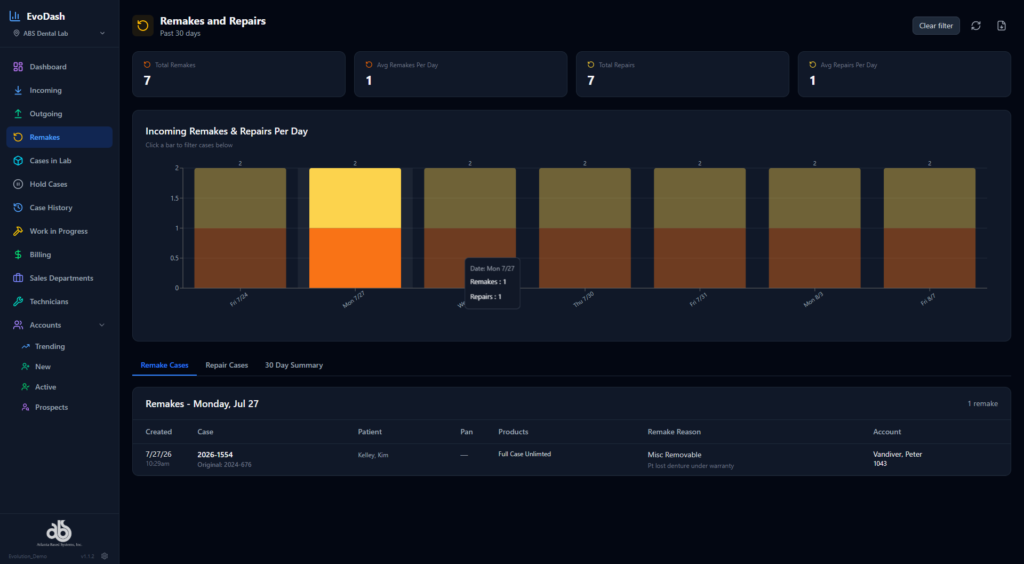
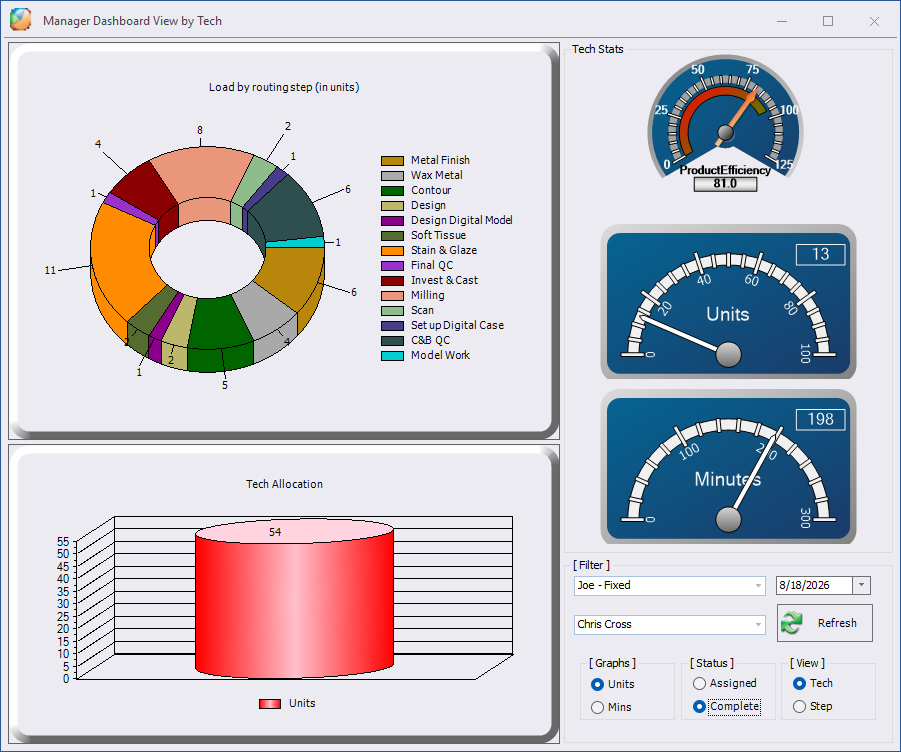
This is the reason we built EvoDASH into the Evolution suite. Not because dashboards are interesting, but because the interval between when a number goes wrong and when a lab owner finds out is where margin disappears. Shortening that interval is most of the job.

What this means for your lab

You do not need to have an opinion about private equity to take something from this cycle. Take the checklist instead.

Pick the three numbers that would most change a decision you are making this quarter. For most labs that is remake rate, units per tech, and how much finished work is still waiting to be billed. Find out what they are this month, not last year. Then look at them again in thirty days.

If that exercise takes you a week, that is the finding. It should take a minute.

See what this looks like in practice

If you have been on Evolution a while and feel like you are not using everything you have, we do free walkthroughs. If you are evaluating a change, we are glad to show you what real-time lab visibility looks like on your own data. Either way, reach out.

Learn more about ABS and Evolution

Follow ABS on Facebook, Instagram, LinkedIn, and X. Please contact us directly if you’d like to learn more about Evolution dental lab management software.
The dental lab workforce has declined by more than 30% since 2004. Restorative demand has not.

The numbers don’t describe a hiring problem

The Bureau of Labor Statistics projects employment for dental and ophthalmic laboratory technicians to decline another 1% through 2034. Over the same period it projects roughly 7,700 openings a year, almost all of them from retirements and people leaving the trade rather than from growth.

Read those together and you get an uncomfortable picture. The industry isn’t contracting because there’s less work. It’s contracting because the bench is aging out faster than it’s being replaced, and the training pipeline was never rebuilt to match.

Meanwhile the number of US dental labs keeps falling. Roughly 4,375 businesses remain, down about 1.6% annually over the last five years, in a market worth around $7.6 billion. Fewer labs. Fewer technicians. Steady demand.

Why the standard playbook is failing

Most labs are running the same response: post the opening, wait, raise the offer, wait longer, and eventually hire someone who needs six months before they’re carrying a full load.

That approach competes for a pool that shrinks every year. You can win it occasionally. You can’t win it structurally, and the labs that keep trying end up paying more for the same output while their competitors quietly get better at something else.

There’s a second cost that’s easier to miss. Every month spent waiting on a hire is a month of turnaround times you can’t commit to, accounts you can’t take on, and overtime that erodes the margin you were protecting.

The lever that’s actually available

The labs pulling ahead have mostly stopped trying to hire their way out. They’ve shifted attention to the space between the case arriving and the case shipping, the only part of this equation they fully control.

That means knowing where technician hours actually go. Not payroll hours. Production hours, by case and by step.

It’s a harder question than it sounds. Most labs know their monthly unit count and their labor cost. Far fewer can say, without building a spreadsheet first, how many hours a case consumed by department, which step is holding up WIP right now, or whose remake rate has been climbing for three months.

That’s rarely a matter of not caring. The data usually already exists somewhere in the lab’s system. What’s missing is a screen that puts it in front of someone who can act on it today rather than at month end.

Where the recovered capacity actually comes from

When labs start measuring this, the gains rarely come from technicians working faster. They come from removing the things that were never production in the first place:

Rework. A remake rate that’s tracked weekly gets addressed while the cause is still identifiable. One tracked quarterly gets absorbed as a cost of doing business.

Case hunting. Time spent locating a case, chasing a missing Rx detail, or asking who has the model is invisible on a timesheet and expensive in aggregate.

Bottlenecks nobody named. Most labs have one step that quietly sets the pace for everything downstream. It’s usually obvious once it’s measured and invisible until then.

None of that requires a hire. All of it requires visibility.

What this means for your lab

Before you write another job posting, answer one question honestly: how many hours per technician per week go to production, and where does the rest of the day go?

If you can’t answer it from your existing system in a few minutes, that’s the first thing to fix. Not because measurement solves the shortage; it doesn’t. But because you can’t recover capacity you can’t see, and recovered capacity is cheaper, faster, and more certain than a hire you can’t find.

See what this looks like in practice

If you’re running a lab and this sounds like your last twelve months, we’re glad to walk through how labs are tracking technician productivity and case flow at the step level: what’s worth measuring, and what’s just noise. No pitch, no commitment.

Grab fifteen minutes on the calendar and we’ll look at your lab specifically.

Book 15 minutes with Adam →

Prefer to send a note first? Contact us and we’ll take it from there.

Learn more about ABS and Evolution

Follow ABS on Facebook, Instagram, LinkedIn, and X. Please contact us directly if you’d like to learn more about Evolution dental lab management software.
Recent Posts
Archives