
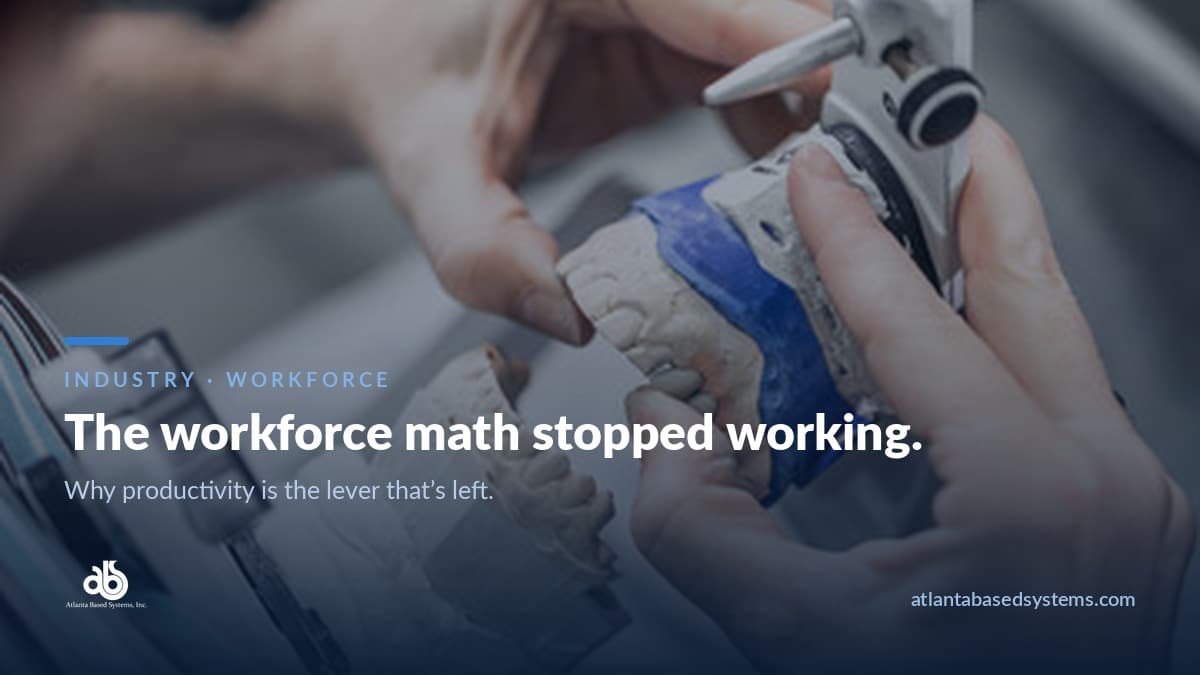
The dental lab workforce has declined by more than 30% since 2004. Restorative demand has not.
The numbers don’t describe a hiring problem
The Bureau of Labor Statistics projects employment for dental and ophthalmic laboratory technicians to decline another 1% through 2034. Over the same period it projects roughly 7,700 openings a year, almost all of them from retirements and people leaving the trade rather than from growth.
Read those together and you get an uncomfortable picture. The industry isn’t contracting because there’s less work. It’s contracting because the bench is aging out faster than it’s being replaced, and the training pipeline was never rebuilt to match.
Meanwhile the number of US dental labs keeps falling. Roughly 4,375 businesses remain, down about 1.6% annually over the last five years, in a market worth around $7.6 billion. Fewer labs. Fewer technicians. Steady demand.
Why the standard playbook is failing
Most labs are running the same response: post the opening, wait, raise the offer, wait longer, and eventually hire someone who needs six months before they’re carrying a full load.
That approach competes for a pool that shrinks every year. You can win it occasionally. You can’t win it structurally, and the labs that keep trying end up paying more for the same output while their competitors quietly get better at something else.
There’s a second cost that’s easier to miss. Every month spent waiting on a hire is a month of turnaround times you can’t commit to, accounts you can’t take on, and overtime that erodes the margin you were protecting.
The lever that’s actually available
The labs pulling ahead have mostly stopped trying to hire their way out. They’ve shifted attention to the space between the case arriving and the case shipping, the only part of this equation they fully control.
That means knowing where technician hours actually go. Not payroll hours. Production hours, by case and by step.
It’s a harder question than it sounds. Most labs know their monthly unit count and their labor cost. Far fewer can say, without building a spreadsheet first, how many hours a case consumed by department, which step is holding up WIP right now, or whose remake rate has been climbing for three months.
That’s rarely a matter of not caring. The data usually already exists somewhere in the lab’s system. What’s missing is a screen that puts it in front of someone who can act on it today rather than at month end.
Where the recovered capacity actually comes from
When labs start measuring this, the gains rarely come from technicians working faster. They come from removing the things that were never production in the first place:
Rework. A remake rate that’s tracked weekly gets addressed while the cause is still identifiable. One tracked quarterly gets absorbed as a cost of doing business.
Case hunting. Time spent locating a case, chasing a missing Rx detail, or asking who has the model is invisible on a timesheet and expensive in aggregate.
Bottlenecks nobody named. Most labs have one step that quietly sets the pace for everything downstream. It’s usually obvious once it’s measured and invisible until then.
None of that requires a hire. All of it requires visibility.
What this means for your lab
Before you write another job posting, answer one question honestly: how many hours per technician per week go to production, and where does the rest of the day go?
If you can’t answer it from your existing system in a few minutes, that’s the first thing to fix. Not because measurement solves the shortage; it doesn’t. But because you can’t recover capacity you can’t see, and recovered capacity is cheaper, faster, and more certain than a hire you can’t find.
See what this looks like in practice
If you’re running a lab and this sounds like your last twelve months, we’re glad to walk through how labs are tracking technician productivity and case flow at the step level: what’s worth measuring, and what’s just noise. No pitch, no commitment.
Grab fifteen minutes on the calendar and we’ll look at your lab specifically.
Prefer to send a note first? Contact us and we’ll take it from there.
Learn more about ABS and Evolution
Follow ABS on Facebook, Instagram, LinkedIn, and X. Please contact us directly if you’d like to learn more about Evolution dental lab management software.