
Ask a lab owner for their remake rate and most can give you a number. Four percent. Three and a half. “Under five, most months.”
It is a reasonable number to track. It is also one of the least useful numbers on the report, because of what it hides.
What the research actually found
A national study of single-unit crowns from the National Dental Practice-Based Research Network, published in the Journal of Prosthodontics, put the average remake rate at 3.8 percent. That matches what most labs would guess about themselves.
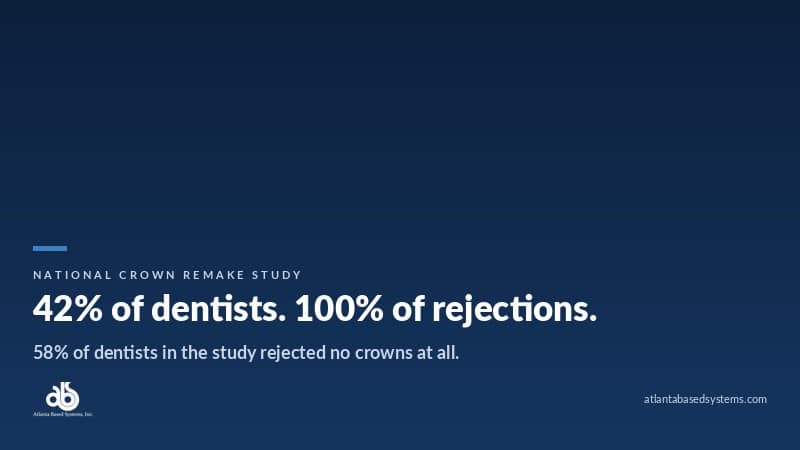
The distribution is the real finding. Individual dentists’ rejection rates ranged from zero to 42 percent. Fifty-eight percent of the dentists in the study rejected no crowns at all. Every rejection in the study came from the other 42 percent.
In other words, remakes were not spread thinly across everyone. They were concentrated in a minority of practices, and a blended average of 3.8 percent described almost nobody accurately.
Why a single percentage sends you to the wrong fix
The same study listed the most common reasons crowns were sent back. Open proximal contacts came first, then open margins, then esthetic failure. Those three reasons have almost nothing in common when it comes to fixing them.
An open contact might be a model problem, a design setting, or a finishing habit. An open margin might be the bench, or it might be the impression that arrived. An esthetic failure is usually a communication problem: shade, photos, expectations. A lab that sees “remakes up this month” and responds with a general push on quality is treating three different problems with one blunt instrument.
The study also recorded what the dentist suspected had gone wrong. The most common answer was lab error, followed by distorted impressions and color mismatch. That is not a verdict. It is the default explanation when nobody has better information, and it tends to become the record unless the lab has its own.
Three questions worth answering every month
Before any remake conversation with a doctor, or any change at the bench, a lab manager should be able to answer three questions without building a spreadsheet.
Where are the remakes coming from? Rank accounts by remake count and by remake rate. The two lists are rarely the same. A high-volume account with a modest rate can produce more remakes than a small account with a terrible one, and they need different responses.
Which reasons keep repeating, and for whom? One account sending back open margins every month is a different conversation from an account whose remakes are all shade. Reasons only mean something once they are tied to the account.
Whose fault was it? Not to assign blame, but to decide who acts. Remakes that trace to the lab are a production issue. Remakes that trace to the prep or the impression are a doctor relationship issue. Most labs have a gut feel for the split. Very few can show it.
Turning the numbers into a conversation
The value of knowing where remakes live is that it changes the tone of the call. “We have noticed a few remakes lately” invites a defensive answer. “Your office sent back six crowns this quarter, four for open margins, and all four were on cases where the impression was taken the same way” is a problem two professionals can solve together.
It also protects the relationships that are working. When a lab responds to a rising average by tightening everything, the accounts that never send anything back feel the friction too. Knowing that most remakes come from a few places lets the lab be precise instead of general.
This is the thinking behind the Remakes screen in EvoDASH, the dashboard that runs on a lab’s Evolution data. It shows remakes and repairs over time, splits remake fault between lab and doctor, lists the accounts sending the most remakes, and lets a manager click a day on the chart to see the cases behind it. The information is already in Evolution. The screen puts it where someone can act on it during the week rather than at month end.
What this means for your lab
Stop reporting remakes as one number. Report them as a short list: the top five accounts by remake count, the top three reasons, and the lab versus doctor split. Review it on a set day every month, with the person who talks to doctors in the room.
If the list surprises you, that is the point. The research suggests most of your accounts are not the problem. The job is finding the ones that are, and having the case history ready when you call.
See your own remake picture
If your lab runs Evolution and you would like to see what your remakes look like broken down by account and reason, we are happy to walk you through it on your own data.
Learn more about ABS and Evolution
Follow ABS on Facebook, Instagram, LinkedIn, and X. Please contact us directly if you’d like to learn more about Evolution dental lab management software.